I map where the work gets stuck, design the system that fixes it, and hand it over so your team owns it
The work is fine.
The admin around it is not.
PROBLEM ONE
PROBLEM TWO
PROBLEM THREE
That friction is expensive. A first project looks at one process, not the whole company.
Example saving: Two people spending 30 minutes a day chasing status is roughly 250 hours a year.
WHAT I DO
A first project looks at one process, rather than trying to rebuild how the whole company works. The useful part is joining the pieces that already exist and do not speak to each other. The due date, the current file, the approval and the name of the person who has to act next all sit in the same place, so nobody has to hunt for them. People can keep using Word, a spreadsheet or chat to discuss the work. Those tools stop being the place the work itself is kept. This is not a new system for the whole company. It is a home for the part of the operation that does not have one.
Focus on one process, not the whole company
The date, the file and the next person, in one place
The solution is pre-agreed before anything is built
Yours once it is handed over
Tools are chosen to fit the work. The work is not bent to fit the tools.
HOW IT WORKS
It starts with a short diagnostic by email. You describe the process that is costing time, and I reply with a written note: what a first version would include, or that a system is not the right next step. If a system is the right solution, you see what is included and what it will cost before anything starts.
The system is then built and handed over, with a short period of support while the team gets used to it. You are not asked to approve a system you have not seen. Once it has been handed over, it belongs to you.
1.
Short diagnostic by email
2.
Clear recommendation and fixed-scope proposal
3.
Build and handover
4.
A short handover, then it is yours
The price . . .
Most first projects sit between £800 and £2,500. The figure depends on the process, not on a day rate that drifts. There is no retainer unless you later want one. All initial builds are delivered on a fixed-fee, fixed-timeline basis. No hidden overruns.
WHO THIS IS FOR
Owners and managers who have grown past “we’ll just message it”. Property, logistics, agencies, and other offices where the work is fine and the admin around it is not. If your team spends more time chasing updates than doing the job, this is the sort of mess I look at.
It's not . . .
. . . a six-month transformation programme and it is not a replacement for the project tool you already have. It is one process, put somewhere the team will actually open.
HOW A FIX USUALLY LOOKS
See How It Works
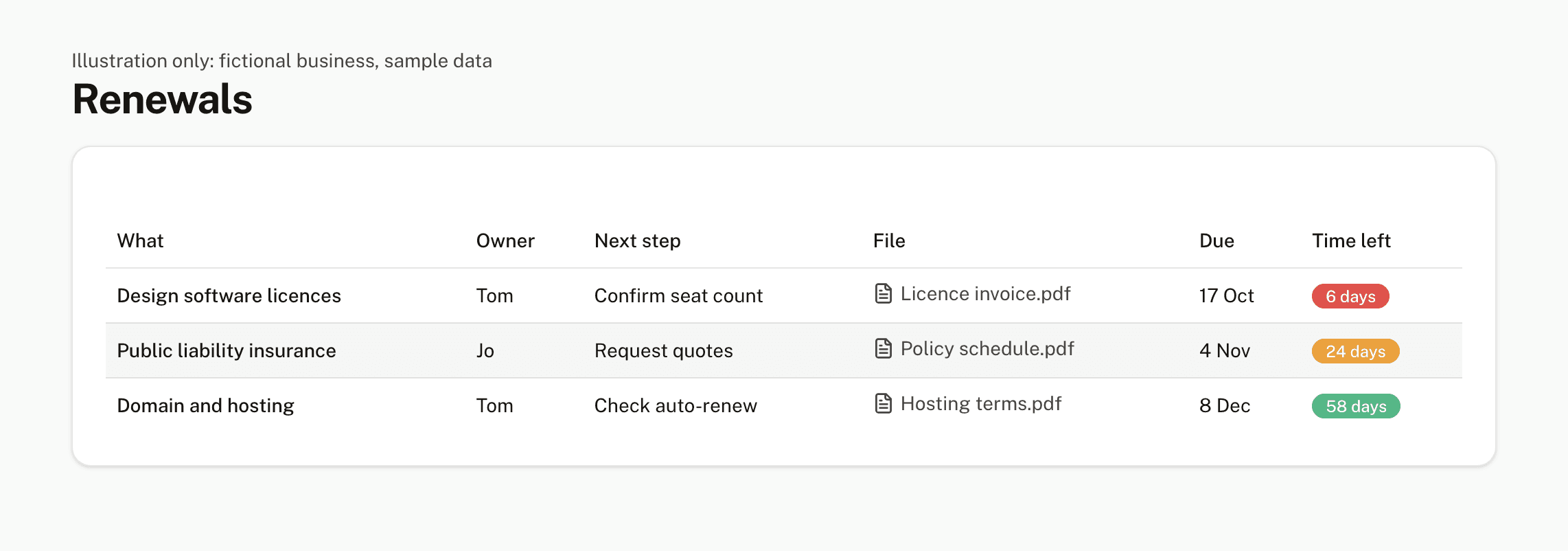
The pictures below show the sort of screen a team ends up with. Each one is a small part of the same place: a date, a file, a decision, a person. Together, they are how someone can see the work without asking. They are illustrations, not jobs done for a named firm. If your week looks like one of them, or like something else entirely, the next step is a diagnostic.
The date only one person remembers

A licence, an insurance, or a domain review is due next month. It is written down somewhere, in a sheet or a diary, and the reminder is that person noticing. In the illustration, the process has its own list: what it is, who owns the next step, when it is due, and the file it depends on. It is not a project plan. It is the one thing that keeps getting missed.
What changes: The due date does not depend on someone remembering to look.
A quote or a draft ends up with three filenames, and the current one is whichever was attached to the last email. In the illustration, the job holds one file, and the decision sits next to it: approved, or sent back, with the date.
What changes: Next month, someone can find the version that was agreed, without asking the person who sent it.

The work is real. The way into it is a handover chat and someone else’s memory. In the illustration, they open the job and see the brief, the file and who has it now. They do not need you in the room to know what “done” looks like.
What changes: The business is less dependent on the person who happens to be in that day.
If that feels familiar, start with a diagnostic.
There is no pitch deck, and no long audit. You describe one process, and you get a written note saying whether a small system would help.
Internal System Solutions is run by me, Paul. You work with me directly. The first conversation is by email.
